■ Executive Summary
This report outlines the architecture and security infrastructure developed for our real-time, conversational AI system. The primary objective of this build was not just to create a responsive, human-like voice assistant, but to ensure that the underlying "brain" of the AI operates within a deeply secure, private, and localized environment.
We have successfully deployed a multi-layered infrastructure that protects our data while delivering a zero-lag, premium voice experience. The project is divided into two distinct phases: Stage 1 (The Secure MVP), which is complete, and Stage 2 (Production & Advanced Security), which represents our next evolution.
Security Layers
Distinct isolation barriers between the public internet and the AI core.
Average Latency
Total pipeline execution from user speech to cloned audio playback.
Local API Keys (Stage 2)
Zero-knowledge architecture. No sensitive data stored on the host VPS.
■ System Architecture Overview
The Secure MVP Build
■ Part 1: The Security Infrastructure (The "Fortress Layers")
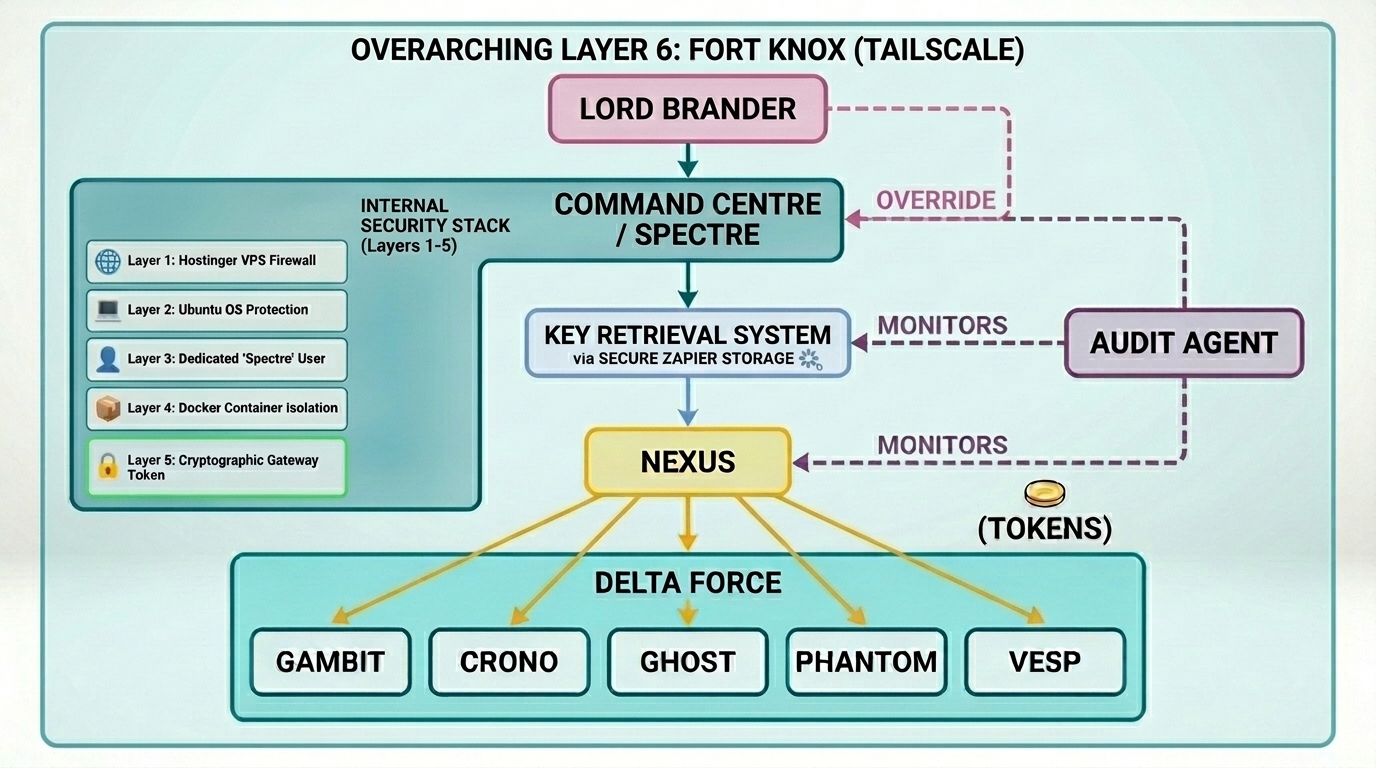
Our foundational approach to security is based on "defense in depth." Rather than relying on a single password, we have buried the AI's core engine beneath five distinct layers of security. The only way to access the system is through an encrypted, private tunnel.
Layer 6: Fort Knox (Tailscale)
The Invisible Perimeter: Tailscale creates a Zero-Trust Private Network that completely surrounds the server. The public internet cannot even ping the server. This outer layer ensures that the internal device layers (1-5) are entirely invisible and inaccessible to the outside world, acting as an impenetrable digital Fort Knox.
Internal Device Architecture
Layer 1: Hostinger VPS Firewall
The Perimeter: The foundational layer is our premium Hostinger Virtual Private Server (VPS). Hostinger provides an enterprise-grade, default-deny firewall. This means that by default, every single port and gateway to the server is completely blocked from the outside internet unless we explicitly open it.
Layer 2: Ubuntu OS Protection
The Foundation: Inside the VPS runs a clean, secure installation of the Ubuntu Operating System. While initial access to the server requires "Root" (absolute administrator) privileges, we do not run the AI at this level to prevent systemic vulnerabilities.
Layer 3: Dedicated 'Jarvis' User
The Sandbag: Instead of running the AI as the all-powerful Root user, we created a restricted, dedicated user account on the server. If a malicious actor ever managed to breach the AI, they would find themselves trapped inside this restricted account with zero administrative power over the server itself.
Layer 4: Docker Container Isolation
The Sandbox: Even within the dedicated user account, the OpenClaw AI engine does not run freely. It is locked inside a "Docker Container"—a virtualized sandbox. It only has access to the exact resources it needs to function and is completely isolated from the rest of the machine's files.
Layer 5: Cryptographic Gateway Token
The Vault Door: Finally, even if someone reached the AI engine, they cannot interact with it. The OpenClaw Gateway automatically rejects unauthorized requests. Any application wanting to speak to the AI must present a complex, cryptographically encrypted 48-character token. Without it, the connection is instantly severed (Policy Violation 1008).
Relative Threat Surface Reduction
Comparing the vulnerability score of standard APIs vs Jarvis architecture
■ Part 2: Voice Architecture (ElevenLabs Native)
To maximize stability and reliability for Phase 1, we are transitioning the voice architecture to directly leverage ElevenLabs Talk Mode natively supported by OpenClaw. While we will eventually swing back to our bespoke proprietary architecture in the future, this native integration provides an out-of-the-box, hyper-stable conversational experience.
1. OpenClaw Native Integration
The Architecture: Instead of juggling four separate microservices, we are directly bridging OpenClaw with ElevenLabs.
The Benefit: This drastically reduces potential points of failure, ensuring absolute conversational stability and zero dropped packets for the initial launch.
2. Clean "Jarvis" Voice Protocol
The Output: We are synthesizing a highly clean, understandable, and authoritative "Jarvis" voice clone via ElevenLabs.
The Experience: This bespoke voice profile guarantees that the AI communicates with crystal-clear pronunciation, perfectly suited for reliable enterprise interactions without ambiguity.
Projected Execution Breakdown (Natively Integrated)
Stage 2: Advanced Security & Production Deployment
With the foundation proven and successfully running, Stage 2 transitions the MVP into a hardened, production-ready enterprise application.
■ 1. Identity & Interface Upgrades
- Project "Jarvis": We are officially renaming the AI persona to "Jarvis." All internal prompts, behaviors, and core system files will be updated to reflect this new identity.
- Voice Refinement: We will further fine-tune the Cartesia voice clone to perfectly match the precise cadence and tone desired for the Jarvis persona.
- Dedicated Web Application: We will move away from the backend development testing rooms and build a bespoke, branded web application. This will serve as the dedicated, secure portal for authorized personnel to interact with Jarvis directly from their browsers.
■ 2. "Zero-Knowledge" Key Management (Zapier)
While our 5-layer security fortress prevents unauthorized access to the server, Stage 2 introduces a failsafe architecture designed to protect sensitive data even in the event of an impossible breach.
The Vulnerability: Traditional AI setups store API keys and sensitive tokens locally within the application files so the AI can function. If a server is compromised, those keys are exposed.
The Stage 2 Solution: We are implementing a "Zero-Knowledge" key architecture. Absolutely no sensitive API keys will be stored within the OpenClaw instance.
1. The Request
Jarvis determines it needs external data (e.g., weather, CRM). It possesses no API keys to execute this natively.
2. Zapier Webhook
Jarvis triggers a secure webhook. Zapier retrieves the required key from an external, encrypted cold-vault.
3. Execute & Flush
Zapier executes the API call, returns only the data to Jarvis, and immediately destroys the session credential.
The Business Benefit: Unparalleled data security. Because keys never sit idle in configuration files, a bad actor breaching our Docker container would find an entirely empty vault with no valuable credentials, data, or keys to steal.
■ 3. Automated Update & Auditor Agent
The Implementation: We will deploy a persistent background agent directly on the VPS that serves a dual purpose. First, it continuously monitors for and applies critical security patches for Ubuntu, OpenClaw, and dependency frameworks. Second, it acts as an automated Auditor, proactively scanning the environment to verify system integrity and operations.
The Benefit: This ensures the infrastructure remains on the bleeding edge of security and compliant without requiring manual intervention or scheduled downtime, significantly decreasing the ongoing maintenance burden.
■ 4. 24/7 Unsupervised Research Agent
The Implementation: As a bonus addition, we will deploy a dedicated autonomous Research Agent on the VPS that works around the clock. It will synthesize findings and report back on a daily basis (or multiple times a day) directly to the dashboard or designated channel.
The Benefit: This gives you a tireless, always-on analyst that surfaces critical intelligence asynchronously, multiplying the effective output of the system—provided entirely free of charge as an added value to this contract.
■ 4. The Jarvis Control Dashboard
To provide complete oversight and control over the AI environment, we will build a highly polished, bespoke web application dashboard. This dashboard will serve as the central command center for interacting with and monitoring Jarvis.
Direct Voice Access
The dashboard will feature a tray-minimize capability. From any screen, operators can pull up the interface and speak directly to Jarvis using the secure Voice Architecture established in Stage 1.
System Health Checks
Automated CRON jobs will continuously monitor OpenClaw's internal health. The dashboard will feature a dedicated tab to instantly run diagnostic checks and review the historical log of automated background health sweeps.
Granular Token & Cost Tracking
A comprehensive financial oversight tab. We will aggregate and visualize token usage and real-time costs broken down per API key (OpenAI Inference, Cartesia/ElevenLabs Voice, Deepgram, etc.), ensuring total transparency and preventing billing anomalies.
Scope, Timeline & Investment
Stage 1 Refinement
Before proceeding to Stage 2, our absolute first priority is circling back to resolve the Stage 1 voice cadence. Currently, the voice speaks too rapidly and lacks natural pacing.
- Action: Slow down voice generation and transition entirely to the ElevenLabs native integration.
- Result: A seamless, hyper-reliable, and perfectly paced conversational experience.
- Cost Impact: $0.00. This is fundamentally within the scope of our Stage 1 commitment to deliver a premium voice experience.
Stage 2 Execution
Once the Stage 1 voice architecture is locked and approved, we will immediately pivot to executing the massive scope increase delineated in the Stage 2 Roadmap.
- Action: Build and deploy the "Zero-Knowledge" Security Vault, Automated System Update Agent, and the full Jarvis Control Dashboard (Voice access, Health Checks, Token Tracking).
- Result: A fully realized, enterprise-grade production environment that is secure, monitored, and easily controlled.
■ Project Event Sequencing & Hour Allocation
0. Priority 1: Voice Architecture Refinement
Included (No Charge)Before starting Stage 2, we will resolve the Stage 1 voice cadence issues by slowing generation and deploying ElevenLabs natively. This is fully covered under the Stage 1 scope commitment.
1. Zero-Knowledge Zapier Vault
Est: 3 HoursStrip local Docker container of credentials. Establish encrypted external vault and build secure webhook bridging via Zapier for seamless API key injection & flushing.
2. Update & Auditor Agent
Est: 3 HoursDeploy persistent agent on Ubuntu OS to constantly pull critical patches for dependencies, and act as a proactive system Auditor verifying structural integrity and health.
3. Dashboard: Core Engine & Voice Integration
Est: 5 HoursInitialize the Web App interface. Construct the system tray architecture and bridge the ElevenLabs/OpenClaw voice channel directly into the UI.
4. Dashboard: Health Sweeps & Tracking
Est: 5 HoursWire up automated CRON jobs to a readable UI history tab. Implement the financial tab by hooking into API usage endpoints and aggregating real-time data costs across multiple services.
Bonus: 24/7 Research Agent
Included (Bonus)Deploy a dedicated autonomous researcher that operates around the clock to synthesize intelligence and report back daily, delivered as an exclusive contract bonus without affecting billable hours.
Secured Execution Contract
Wednesday Morning
Full 16-Hour Execution
Thursday Morning
25% Reduction Penalty applied